
"I was cowardly." A German policeman explains why he shot Jews at Jozefow, 1942. The average number of murdered Jews per policeman in his battalion was over 500.
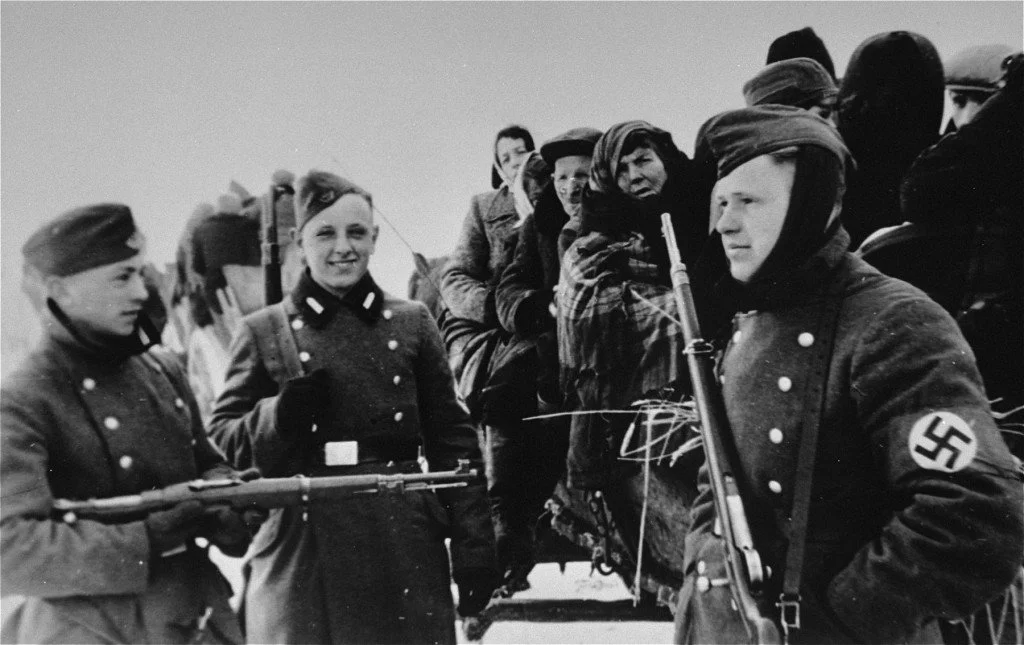
Deportation from the Zychlin ghetto, March 1942. German policemen oversee the removal of Jews to the Chelmno killing center. United States Holocaust Memorial Museum, courtesy YIVO Institute for Jewish Research.
On July 13, 1942, the Nazi Reserve Police Battalion 101 carried out its first mass killing operation at Jozefow, a Polish village in the Lublin district. Major Wilhelm Trapp, the battalion commander, wept as he gave the order. He then made an offer that has no parallel in the Holocaust's operational record: any older man who did not feel up to the task could step out. Of roughly five hundred men, about a dozen did. By the end of the day, the battalion had shot approximately 1,500 Jewish men, women, and children. It would be the first of hundreds of thousands they would murder over the course of the war.
Ordinary Men, first published in 1992 and revised in 2017, reconstructs the actions of the battalion through postwar judicial interrogations conducted by the Hamburg prosecutor's office in the 1960s. The battalion was composed of middle-aged reservists from Hamburg, working-class and lower-middle-class men, many with families, most with no ideological commitment to National Socialism. They were not SS. They were not volunteers. They were ordinary men, which is the book's argument and its horror.
At Józefów a mere dozen men out of nearly 500 had responded instinctively to Major Trapp's offer to step forward and excuse themselves from the impending mass murder. Why was the number of men who from the beginning declared themselves unwilling to shoot so small? In part, it was a matter of the suddenness. There was no forewarning or time to think, as the men were totally "surprised" by the Józefów action. Unless they were able to react to Trapp's offer on the spur of the moment, this first opportunity was lost.
As important as the lack of time for reflection was the pressure for conformity—the basic identification of men in uniform with their comrades and the strong urge not to separate themselves from the group by stepping out. The battalion had only recently been brought up to full strength, and many of the men did not yet know each other well; the bonds of military comradeship were not yet fully developed. Nonetheless, the act of stepping out that morning in Józefów meant leaving one's comrades and admitting that one was "too weak" or "cowardly." Who would have "dared," one policeman declared emphatically, to "lose face" before the assembled troops. "If the question is posed to me why I shot with the others in the first place," said another who subsequently asked to be excused after several rounds of killing, "I must answer that no one wants to be thought a coward." It was one thing to refuse at the beginning, he added, and quite another to try to shoot but not be able to continue. Another policeman—more aware of what truly required courage—said quite simply, "I was cowardly."
Most of the interrogated policemen denied that they had any choice. Faced with the testimony of others, many did not contest that Trapp had made the offer but claimed that they had not heard that part of the speech or could not remember it. A few policemen made the attempt to confront the question of choice but failed to find the words. It was a different time and place, as if they had been on another political planet, and the political values and vocabulary of the 1960s were useless in explaining the situation in which they had found themselves in 1942. Quite atypical in describing his state of mind that morning of July 13 was a policeman who admitted to killing as many as twenty Jews before quitting. "I thought that I could master the situation and that without me the Jews were not going to escape their fate anyway. . . . Truthfully I must say that at the time we didn't reflect about it at all. Only years later did any of us become truly conscious of what had happened then. . . . Only later did it first occur to me that had not been right."
In addition to the easy rationalization that not taking part in the shooting was not going to alter the fate of the Jews in any case, the policemen developed other justifications for their behavior. Perhaps the most astonishing rationalization of all was that of a thirty-five-year-old metalworker from Bremerhaven:
I made the effort, and it was possible for me, to shoot only children. It so happened that the mothers led the children by the hand. My neighbor then shot the mother and I shot the child that belonged to her, because I reasoned with myself that after all without its mother the child could not live any longer. It was supposed to be, so to speak, soothing to my conscience to release children unable to live without their mothers.
The full weight of this statement, and the significance of the word choice of the former policeman, cannot be fully appreciated unless one knows that the German word for "release" (erlösen) also means to "redeem" or "save" when used in a religious sense. The one who "releases" is the Erlöser—the Savior or Redeemer!
In terms of motivation and consciousness, the most glaring omission in the interrogations is any discussion of anti-Semitism. For the most part the interrogators did not pursue this issue. Nor were the men, for understandable reasons as potential defendants, eager to volunteer any illuminating comments. With few exceptions the whole question of anti-Semitism is marked by silence. What is clear is that the men's concern for their standing in the eyes of their comrades was not matched by any sense of human ties with their victims. The Jews stood outside their circle of human obligation and responsibility. Such a polarization between "us" and "them," between one's comrades and the enemy, is of course standard in war. It would seem that even if the men of Reserve Police Battalion 101 had not consciously adopted the anti-Semitic doctrines of the regime, they had at least accepted the assimilation of the Jews into the image of the enemy. Major Trapp appealed to this generalized notion of the Jews as part of the enemy in his early-morning speech. The men should remember, when shooting Jewish women and children, that the enemy was killing German women and children by bombing Germany.
If only a dozen policemen stepped out at the beginning to extricate themselves from the impending mass murder, a much larger number either sought to evade the shooting by less conspicuous methods or asked to be released from the firing squads once the shooting had begun. How many policemen belonged to these categories cannot be ascertained with any certainty, but an estimate in the range of 10 to 20 percent of those actually assigned to the firing squads does not seem unreasonable. Sergeant Hergert, for instance, admitted excusing as many as five from his squad of forty or fifty men. In the Drucker-Steinmetz group, from which the greatest number of shooters was interrogated, we can identify six policemen who quit within four rounds and an entire squad of five to eight who were released considerably later. While the number of those who evaded or dropped out was thus not insignificant, it must not obscure the corollary that at least 80 percent of those called upon to shoot continued to do so until 1,500 Jews from Józefów had been killed.
Browning, Christopher R. Ordinary Men: Reserve Police Battalion 101 and the Final Solution in Poland. Revised ed. New York: Harper Perennial, 2017. p.82-85
Christopher Browning is a historian at the University of North Carolina at Chapel Hill and one of the foremost scholars of the Holocaust's operational mechanics. Stanley Milgram's obedience experiments at Yale in the early 1960s demonstrated that roughly two-thirds of participants would administer what they believed were lethal electric shocks when instructed by an authority figure. Browning draws on Milgram throughout Ordinary Men, but the Jozefow data breaks the framework. Milgram's subjects obeyed because authority was immediate, constant, and insistent. Trapp's men were given explicit permission to refuse. The authority figure was weeping. The pressure came from beside, not above: from the men standing in the same row, from the shared understanding that stepping out meant declaring yourself weaker than the man next to you.
The one policeman who called himself a coward had the clearest view of the situation. He understood that the real courage was in the refusal, and he named his failure to refuse for what it was. The metalworker from Bremerhaven, who shot children and called it mercy using the German word erlosen, which carries the religious weight of "redeem" and "save," had the most obscured view: a man who built a theological architecture around the act of killing a child so that the killing became, in the grammar of his own language, salvation.
The men who reframed their participation as toughness were building the self-justification that would carry them through the next eighteen months of operations. Eighty percent of those assigned to the firing squads continued to the end.
History teaches us it does not require enthusiasm to become a mass murder. It requires the absence of refusal.