
"A cash settlement at public expense." The pension reform that ended the Roman Republic's cycle of civil war.
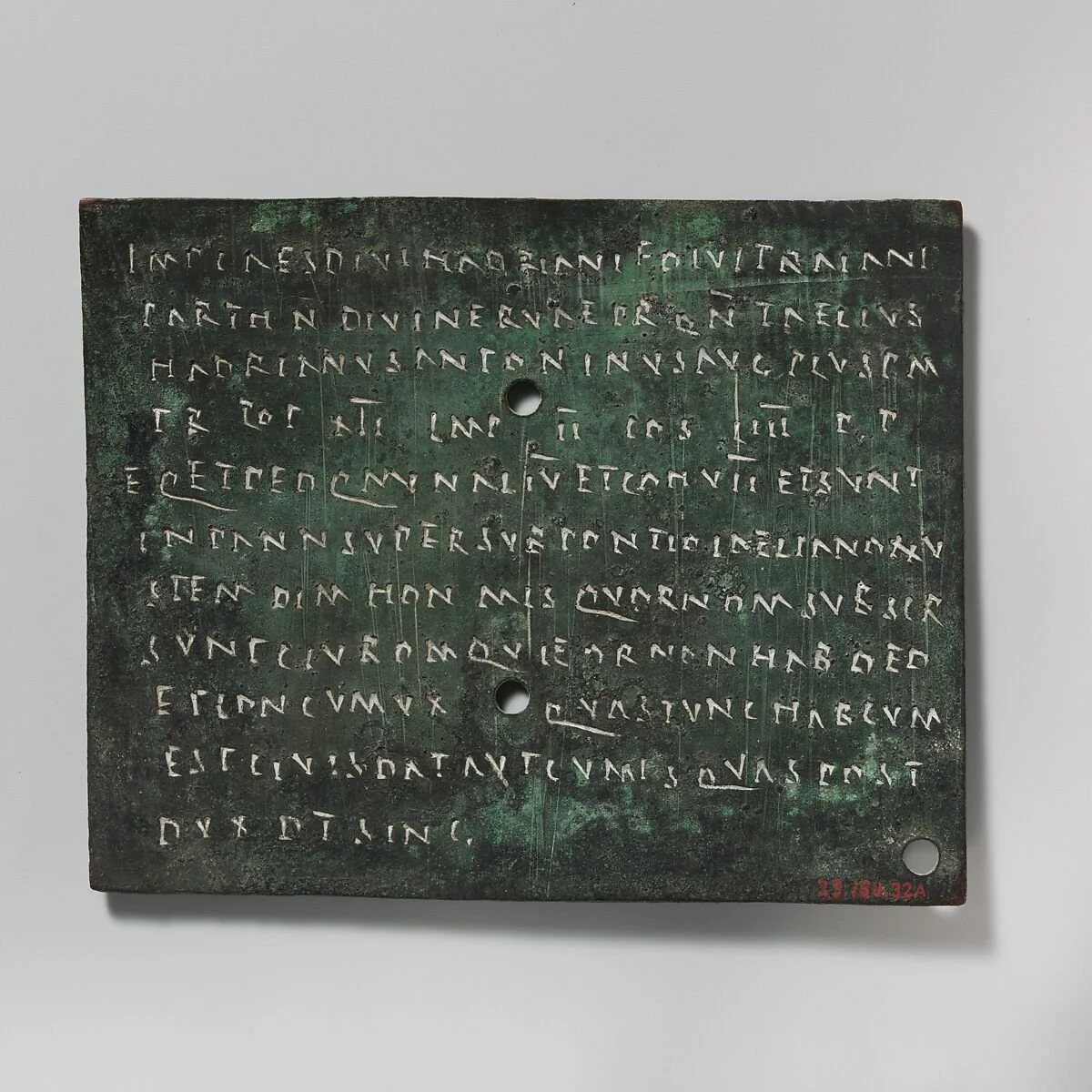
Bronze military diploma, AD 149. The discharge certificate that formalized Augustus's pension system, transforming soldiers from personal retainers into state employees. Metropolitan Museum of Art.
Augustus's most consequential innovation also happened to be his least dramatic: pension reform. For the last century of the Republic, Roman soldiers depended on their individual generals to provide for their retirement, usually through grants of land in Italy. This meant soldiers' loyalty ran to their commander, not to the state, and every successful general became a potential warlord. Sulla marched on Rome in 88 BCE, Caesar crossed the Rubicon in 49, and Antony and Octavian fought at Actium in 31. The structural cause of every civil war was the same: armies followed paychecks, and whoever signed the checks commanded the loyalty. Augustus reformed it with fixed terms of service, standard pay, and a retirement payout funded by public revenue rather than a general's personal war chest.
He took a monopoly on military force, but his regime was nothing like a modern military dictatorship. In our terms, Rome and Italy at this period were remarkably soldier free. Almost all the 300,000 Roman troops were stationed a safe distance away, near the boundaries of the Roman world and in areas of active campaigning, with only a very few troops, including the famous security forces known as the Praetorian Guard, based in Rome, which was otherwise a demilitarised zone. But Augustus became something no Roman had been before: the commander-in-chief of all the armed forces, who appointed their major officers, decided where and against whom the soldiers should fight, and claimed all victories as by definition his own, whoever had commanded on the ground.
He also secured his position by severing the links of dependence and personal loyalty between armies and their individual commanders, largely thanks to a simple, practical process of pension reform. This must count among the most significant innovations of his whole rule. He established uniform terms and conditions of army employment, fixing a standard term of service of sixteen years (soon raised to twenty) for legionaries and guaranteeing them on retirement a cash settlement at public expense amounting to about twelve times their annual pay or an equivalent in land. That ended once and for all the soldiers' reliance on their generals to provide for their retirement, which over the last century of the Republic had repeatedly led to the soldiers' private loyalty to their commander trumping their loyalty to Rome. In other words, after hundreds of years of a semi-public, semi-private militia, Augustus fully nationalised the Roman legions and removed them from politics. Although the Praetorian Guard continued to be a problematic political force, simply because of its proximity to the centre of power in Rome, only during two brief periods of civil war over the next two centuries, in the years 68 to 69 CE and again in 193 CE, were legions stationed outside the city instrumental in putting their candidates on the Roman throne.
This reform was one of the most expensive things Augustus ever did, and it was close to unaffordable. Unless he made a gross error in his arithmetic, the cost alone is an indication of the high priority he gave it. On a rough reckoning using the known military salary figures, the annual bill for regular pay combined with retirement packages for the whole army would now have come to about 450 million sesterces. That was, on an even rougher reckoning, the equivalent of more than half the total annual tax revenue of the empire. There are clear signs that, even with the huge reserves of state and emperor combined, it was hard to find the money. That is certainly the implication of the complaints of mutinous soldiers on the German frontier just after Augustus' death, who objected to being kept in service for much longer than the regulation twenty years or to being given a piece of worthless bog as a land settlement in lieu of a decent farm. Then as now, the easiest tactic for a government trying to reduce the pension bill was to raise the pension age.
Beard, Mary. SPQR: A History of Ancient Rome (Liveright, 2015), pp. 369-370.
Mary Beard is a classicist at Cambridge and the author of SPQR (2015), a history of Rome from its origins to the early third century CE. The book was written for a general audience and became an international bestseller, which did not diminish its scholarship. Lawrence Keppie's *The Making of the Roman Army (*1998) traced the slow transformation Beard describes from the citizen-soldier militia of the middle Republic, in which men served for a single campaign and went home, to the professional standing army Augustus formalized. The shift had been underway for two centuries, but Augustus severed the bond of patronage that had turned Roman armies into private political instruments by making the state a better patron than any individual commander could be.
Adrian Goldsworthy's The Roman Army at War (1996) noted the geographic consequence: with retirement secured by the treasury rather than by Italian land grants, soldiers could be stationed permanently on the empire's frontiers. Rome and Italy became a demilitarized zone. Three hundred thousand troops sat on the borders. Only the Praetorian Guard remained in the capital, and even that arrangement eventually produced the problem Augustus had tried to eliminate: armed men too close to the center of power with opinions about who should hold it. The system held for two centuries. When it broke, in 68-69 CE and again in 193, the failure confirmed how fundamental the original problem was: armies follow paychecks, and whoever signs the checks commands the loyalty.