
"Docile, tractable, lighthearted, care free." The 1937 Army War College study's assessment of Black soldiers, written in the language of plantation fiction and used as military policy through 1945.
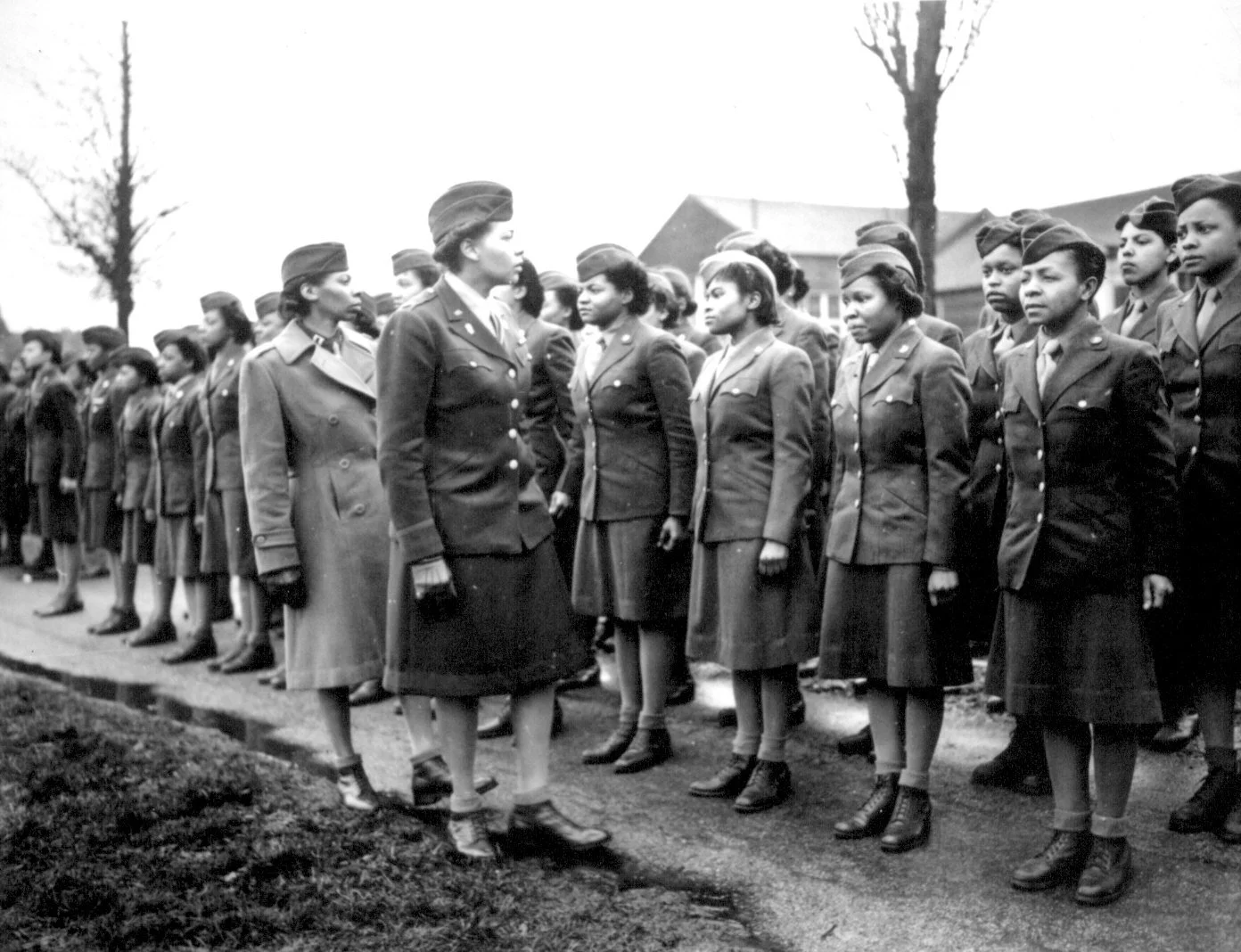
"Somewhere in England." Maj. Charity E. Adams and Capt. Abbie N. Campbell inspect the first contingent of Black members of the Women's Army Corps assigned to overseas service. 6888th Central Postal Directory Battalion, February 15, 1945. National Archives, 111-SC-200791.
In 1937, senior officers at the U.S. Army War College produced a study assessing the military capabilities of Black soldiers. The study's conclusions became policy for the next eight years. Its language drew on racial pseudoscience and the vocabulary of plantation fiction, describing Black Americans as "docile, tractable, lighthearted, care free" and ranking their intelligence as inferior to white soldiers by nature rather than by training. The study examined two Black divisions that had fought in France in 1918, one under French command, which performed well, and one under American command with white Southern officers and inadequate training, which performed poorly. The War College studied the failure, ignored the success, and drew the conclusion the institution had already reached.
By March 1944, approximately 150,000 Black American soldiers were stationed in the United Kingdom, the vast majority assigned to Services of Supply: unloading ships, driving trucks, building roads. A social collision followed American soldiers’ arrival: Black soldiers discovered that Britain had no color line, and white American soldiers discovered that British women did not share American racial categories.
Racism was at the heart of the Nazi philosophy. Racism was also present in the American army. In 1937 senior officers at the U.S. Army War College had done a study to assess the strengths and weaknesses of black soldiers. Their conclusion was that "as an individual the negro is docile, tractable, lighthearted, care free and good natured. If unjustly treated he is likely to become surly and stubborn, though this is usually a temporary phase. He is careless, shiftless, irresponsible and secretive. He resents censure and is best handled with praise and by ridicule. He is unmoral, untruthful and his sense of right doing is relatively inferior." As to strengths, "the negro is cheerful, loyal and usually uncomplaining if reasonably well fed. He has a musical nature and a marked sense of rhythm. His art is primitive. He is religious. With proper direction in mass, negroes are industrious. They are emotional and can be stirred to a high state of enthusiasm."
In World War I, two black U.S. divisions had fought in France. One, serving with the French army, did well; it won many medals and a request from the French for more black troops. The other, serving with the American army, with white Southerners as officers and woefully inadequate training and equipment, did poorly. The War College officers in 1937 concentrated on the failure and ignored the success, which led them to conclude that blacks were not capable of combat service. Consequently, although three black infantry divisions were organized for World War II, only one, the 92nd Infantry, saw combat.
By March 1944, there were about 150,000 black American soldiers in the United Kingdom. Most of them were in Services of Supply, mainly working at the ports unloading ships or driving trucks. They were strictly segregated. In the mythology of the time, this did not mean they were objects of discrimination. Separate but equal was the law of the land back home, and in Britain. General Eisenhower issued a circular letter to senior American commanders that ordered, "Discrimination against Negro troops must be sedulously avoided." But, he acknowledged, in London and other cities "where both Negro and White soldiers will come on pass and furlough, it will be a practical impossibility to arrange for segregation so far as welfare and recreation facilities are concerned." When the Red Cross could not provide separate clubs for blacks, Eisenhower insisted that the blacks be given equal access to all Red Cross clubs. But he went on to tell local commanders to use "their own best judgment in avoiding discrimination due to race, at the same time minimizing causes of friction through rotation of pass privileges." In other words, where there was only one Red Cross club in an area, or only a few pubs, the black soldiers would have passes one night, the whites on another.
The Red Cross built twenty-seven separate clubs for black troops, but they were not enough. There was some mixing of races in white clubs, and even more in the pubs. Some ugly scenes resulted. Fist fights almost always broke out when black and white GIs were drinking in the same pub. There were some shootings, most by whites against blacks (Maj. Gen. Ira Eaker, commander of the Eighth Air Force, declared that white troops were responsible for 90 percent of the trouble), and a few killings—all covered up by the Army.
Eisenhower sent out another circular letter. He told his senior officers that in the interests of military efficiency "the spreading of derogatory statements concerning the character of any group of U.S. troops, either white or colored, must be considered as conduct prejudicial to good order and military discipline and offenders must be promptly punished.... It is my desire that this be brought to the attention of every officer in this theater. To that end, I suggest that you personally talk this over with your next senior commander and instruct them to follow up the subject through command channels." Lt. Gen. J.C.H. Lee, commanding Services of Supply and thus the man with the most at stake, ordered every one of his officers to read Eisenhower's letter to their immediate subordinates and warned that "General Eisenhower means exactly what he says."
The order had little effect. The racial incidents continued. Eisenhower ordered a survey done on soldiers' mail; officers censoring the enlisted men's letters reported that most white troops commented, with varying degrees of amazement, on the absence of segregation in Britain. They were indignant about the association of British women with black soldiers. They expressed fears about what effect the experience American blacks had in Britain would lead to back home after the war. Black soldiers, meanwhile, expressed pleasure with the English and delight at the absence of a color line. One officer, after analyzing censorship reports for several weeks, reported toward the end of May 1944, that "the predominant note is that if the invasion doesn't occur soon, trouble will."
Stephen E. Ambrose, D-Day: June 6, 1944 — The Climactic Battle of World War II (Simon & Schuster, 1994), pp. 158-160.
Stephen Ambrose places this passage in his D-Day narrative (1994) between discussions of training schedules and equipment allocations. Graham Smith's When Jim Crow Met John Bull (1987) and Ulysses Lee's official Army history, The Employment of Negro Troops (1966), documents in exhaustive detail how the 1937 War College study became policy. Three Black infantry divisions were organized for the next war, and only one saw combat. Eisenhower's headquarters tried to hold both black and white realities together with circular letters instructing that "discrimination must be sedulously avoided" while simultaneously rotating pass nights so the races would not share the same town on the same evening. For Eisenhower and the Allied High Command, institutional racism was more a logistics problem than an ideological cause.