
"To Oscar Wilde posing Somdomite." The Marquess of Queensberry's misspelled calling card that destroyed Wilde, 1895, and how it connects to the Norman Conquest.
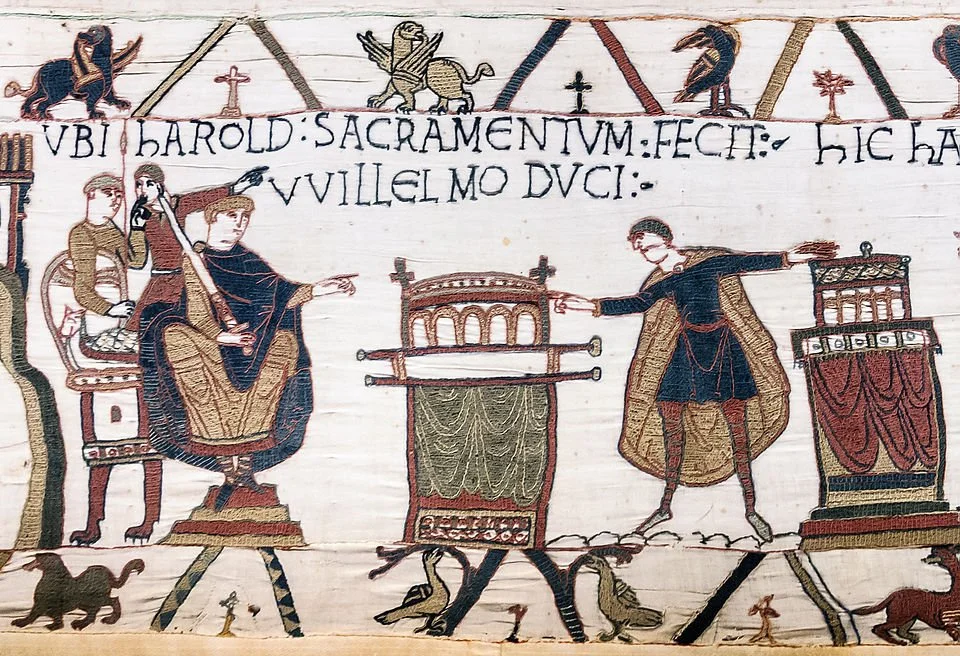
Bayeux Tapestry detail: Harold swears his oath to William of Normandy, c. 1064. Musee de la Tapisserie de Bayeux.
In 1066, swearing was a lot more than just a bad word. It was an oath's power derived from the divine: Harold Godwinson's alleged oath to William of Normandy, sworn on holy relics under what Harold later claimed were false pretenses, was the legal basis for the Norman invasion of England. The Bayeux Tapestry depicts the oath scene prominently because without it, William's claim was a land grab; with it, William had a case that the Pope endorsed.
Hughes traces the decline from that level of political consequence to 1895, when the Marquess of Queensberry left a misspelled calling card at Oscar Wilde's Albemarle Club. Queensberry's card, which read "To Oscar Wilde posing Somdomite," was handed to Wilde by the hall porter. Wilde's decision to sue for libel set in motion the chain of events that ended with his imprisonment and destruction. The calling card was closer in function to a Norse nid, the insult-verse that carried legal consequences, than to a modern slur: Queensberry was making a public accusation that under Victorian law required either retraction or proof.
In the past, when honour and language were more closely interlinked, oaths (or their abrogation) changed the fates of nations. For instance, William of Normandy's claim to the English throne depended initially on no more than his word that Edward the Confessor had formally named him as his successor. When his rival, Harold Godwinson, was shipwrecked and captured on the Normandy coast, William granted him his freedom only upon the exaction of an oath supporting this claim (against Harold's own). However, Harold was subsequently named by Edward the Confessor as his successor, was elected by the English witenagemot (Privy Council) and crowned, so that William had to assert his claim by conquest.
Duels have been fought over words carrying only the faintest implication of dishonour. The intensely personal commitment which an oath requires was vividly apparent when Francis I of France abrogated a treaty and declared war on Spain in 1528. Charles V of Spain accused Francis of ungentlemanly behaviour and challenged him to a duel. (It did not take place.) We cannot imagine a similar consequence arising from, for example, Chamberlain challenging Hitler to a duel on the parallel grounds of the Führer's abrogation of their agreement signed at Munich in 1938.
Personal insults can likewise have devastating consequences, belying the naive, childish chant: 'Sticks and stones may break my bones, but words will never hurt me'. One of the more spectacular social instances arose from the visiting card delivered by the Marquess of Queensberry to the Albermarle Club on 18 February 1894 with the words 'To Oscar Wilde posing Somdomite [sic]' (Ellmann, 1988, p. 412). This precipitated the lawsuit and accompanying society scandal which ruined Wilde. Today such a sexual slur would be less likely to incur litigation. Indeed, a review of a recent biography of Truman Capote began in cavalier fashion: 'Truman Capote was the sort who gives sodomy a bad name.' Nevertheless, oaths, curses and insults directed at individuals can still have serious repercussions. In modern times, however, cases of crimen injuria are more likely to arise from racist slurs than sexual insults.
Geoffrey Hughes, Swearing: A Social History of Foul Language, Oaths and Profanity in English (Penguin, 1991), pp. 29-30.
Geoffrey Hughes published Swearing: A Social History of Foul Language, Oaths and Profanity in English in 1991. The book traces the evolution of English swearing from Anglo-Saxon oath culture through the profanity of the late twentieth century, treating sworn language as a social institution with its own history of power, degradation, and enforcement.
The trajectory Hughes maps covers eight centuries in two pages. In 1066, an oath's power derived from the divine: breaking an oath sworn on holy relics was an offense against God, and the Bayeux Tapestry depicted Harold's perjury as moral justification for his death at Hastings. In 1895, the power derived from statute: the Criminal Law Amendment Act of 1885 had criminalized gross indecency between men, and Queensberry's misspelled card drew its force from that law. Both events turned on language producing catastrophic consequences for the person on the receiving end. The source of the language's authority migrated from God to Parliament, from sacred to social. The words themselves weakened over those eight centuries, but the damage words can do held steady.