
"Make money, but do not spend it." The full Protestant ethic that colonialism deliberately transmitted in halves, from Boahen's African Perspectives on Colonialism.
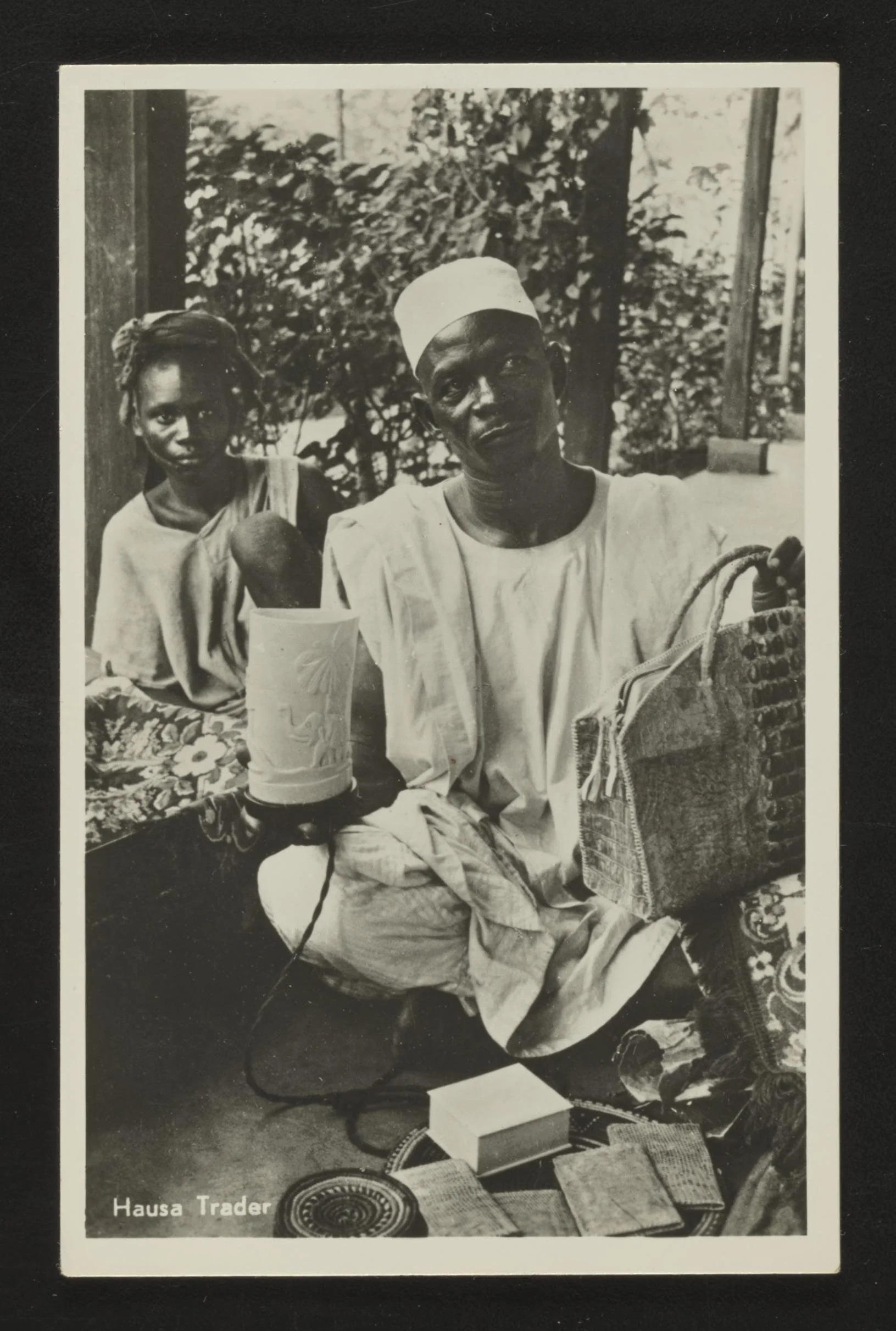
Hausa trader, northern Nigeria, ca. 1900. Library of Congress, Africana Historic Postcard Collection.
A. Adu Boahen published African Perspectives on Colonialism in 1987 based on his Gauss Lectures at Princeton. Boahen was a Ghanaian historian at the University of Ghana, Legon, and one of the leading figures in the generation of African scholars who rewrote the continent's history from the inside after independence. The book catalogs colonialism's legacies across the economic, political, social, and psychological domains, treating the colonial period not as background to the present but as a system with identifiable mechanisms and measurable outputs.
The passage draws on the Kenyan political scientist Ali Mazrui for an observation about selective transmission. Mazrui noticed that the colonial system needed African subjects to desire European goods, because consumer demand was the mechanism that pulled raw materials out of colonies and manufactured goods in. What the system did not need was African capital accumulation, because accumulated capital funds independent enterprise, and independent enterprise competes with metropolitan firms. The half-lesson was not an accident; it was a design feature.
But the last and the most serious negative impact of colonialism has been psychological. This is seen, first, in the creation of a colonial mentality among educated Africans in particular and also among the populace in general. This mentality manifests itself in the condemnation of anything traditional, in the preference for imported goods to locally manufactured goods (since independence), and in the style of dress—such as the wearing of three-piece suits in a climate where temperatures routinely exceed eighty degrees Fahrenheit. Above all, it manifests itself in the belief so prevalent among Africans, both literate and illiterate, that government and all public property and finance belong, not to the people, but to the colonial government, and could and should therefore be taken advantage of at the least opportunity, a belief which leads to the often reckless dissipation and misuse of public funds and property.
Another psychological impact is apparent in ostentatious and flamboyant life-styles, especially on the part of the elite and businessmen. All this arose from the fact that while the colonialists taught their colonial subjects the Protestant work ethic, the drive for worldly success, and the acquisitive instinct, they did not, for obvious reasons, inculcate in them the puritanical spirit which emphasized frugality and very little consumption. In other words, colonialism taught its subjects only part of the puritanical lesson of "make money," not the full one of "make money but do not spend it," which, according to Ali Mazrui, "seemed to be the ultimate commercial imperative operating within the Protestant ethic." Thus, while in Europe this full ethic led to the rise of capitalism, as both Weber and Tawney have clearly shown, and with it the scientific and technological breakthrough, in the African colonies it only generated the ostentatious consumption habits which are still very much with us.
The final and worst psychological impact has been the generation of a deep feeling of inferiority as well as the loss of a sense of human dignity among Africans. Both complexes were surely the outcome not only of the wholesale condemnation of everything African already referred to but, above all, of the practice of racial discrimination and the constant humiliation and oppression to which Africans were subjected throughout the colonial period. The sense of human dignity seems to have been regained but the feeling of inferiority has not entirely disappeared even after two decades of independence.
A. Adu Boahen, African Perspectives on Colonialism (Johns Hopkins University Press, 1987), pp. 107-108.
Walter Rodney's How Europe Underdeveloped Africa (1972) documents the deliberate suppression of African industrialization: colonial policies prohibiting manufacturing, restricting credit to African entrepreneurs, maintaining monopolies for European trading companies. The incomplete transmission of the Protestant ethic was the cultural expression of an economic policy. Boahen follows Mazrui's economic argument with a psychological one: the "deep feeling of inferiority" and "loss of a sense of human dignity" were produced by the same mechanism that produced the consumption patterns. Systematic condemnation of everything African, combined with daily racial humiliation, generated both the consumer and the self-doubt. Fanon anatomized this in Black Skin, White Masks (1952). Boahen, writing in 1987, two decades after independence, observed that the dignity had been partially recovered, but the feelings of inferiority had not.