
"PEACE ON EARTH, GOOD WILL TO MEN." The banner hanging in the church where survivors of the Wounded Knee massacre were carried, December 1890.
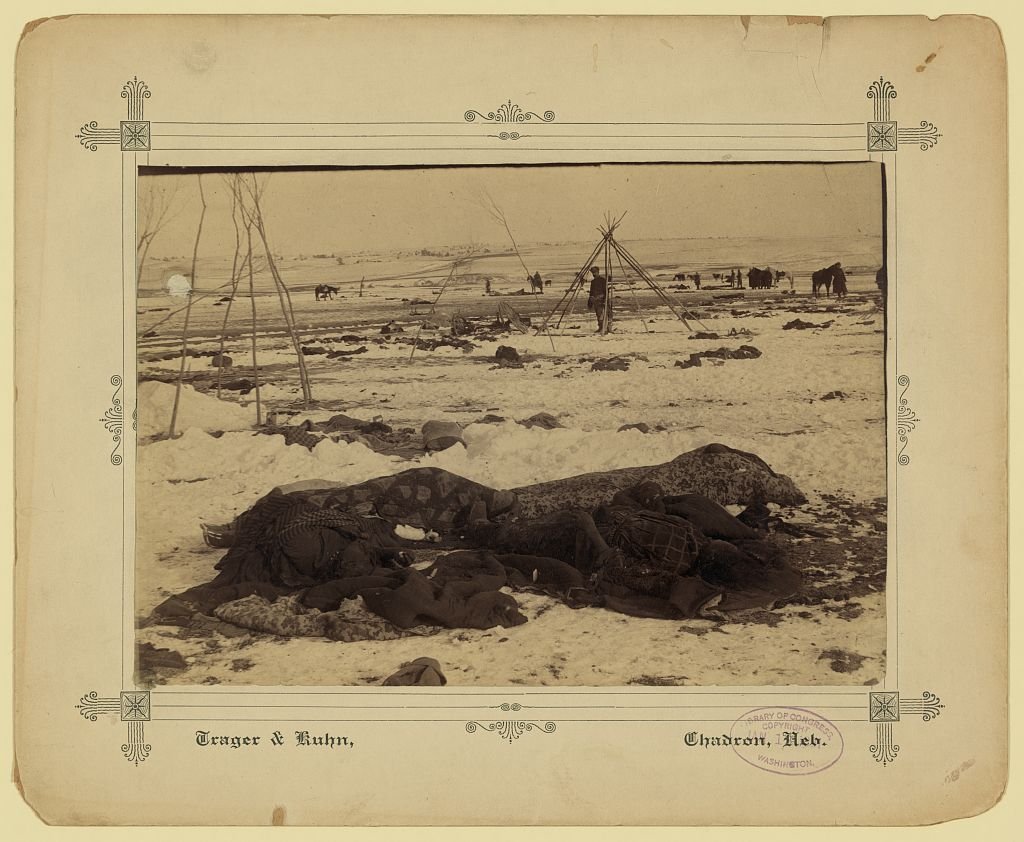
Spotted Elk's camp three weeks after the Wounded Knee massacre, still-frozen bodies wrapped in blankets. Photograph by Trager and Kuhn, January 1891. Library of Congress, Prints and Photographs Division.
The massacre at Wounded Knee Creek on December 29, 1890, killed between 250 and 300 Lakota Sioux, the majority of them women and children. The Seventh Cavalry had been sent to disarm Spotted Elk's band, which had been practicing the Ghost Dance, a spiritual movement that alarmed the Bureau of Indian Affairs into issuing panic telegrams requesting military intervention. The Seventh Cavalry carried institutional memory of the Little Bighorn and brought it to Pine Ridge: twenty soldiers received the Medal of Honor for the engagement, decorations that Lakota activists have been petitioning Congress to rescind since 1990.
Dee Brown published Bury My Heart at Wounded Knee in 1970, and it sold over four million copies in its first decade. The book traces the systematic dispossession of Native peoples across the American West from 1860 to 1890, told entirely from Indigenous perspectives through treaties, speeches, and testimony. Brown was a librarian at the University of Illinois, not a professional historian, and the academic establishment received the book with the wariness institutions reserve for work that reaches a public they have failed to reach themselves. Vine Deloria Jr.'s Custer Died for Your Sins (1969) had appeared the year before; together the two books reframed popular understanding of westward expansion in ways the profession is still absorbing.
Dee Brown chose to end his book in the aftermath, in the Episcopal mission where the wounded were carried. The passage closes with Black Elk's testimony, recorded forty-two years later by John Neihardt on the reservation.
In the first seconds of violence, the firing of carbines was deafening, filling the air with powder smoke. Among the dying who lay sprawled on the frozen ground was Big Foot. Then there was a brief lull in the rattle of arms, with small groups of Indians and soldiers grappling at close quarters, using knives, clubs, and pistols. As few of the Indians had arms, they soon had to flee, and then the big Hotchkiss guns on the hill opened up on them, firing almost a shell a second, raking the Indian camp, shredding the tepees with flying shrapnel, killing men, women, and children.
"We tried to run," Louise Weasel Bear said, "but they shot us like we were a buffalo. I know there are some good white people, but the soldiers must be mean to shoot children and women. Indian soldiers would not do that to white children."
"I was running away from the place and followed those who were running away," said Hakiktawin, another of the young women. "My grandfather and grandmother and brother were killed as we crossed the ravine, and then I was shot on the right hip clear through and on my right wrist where I did not go any further as I was not able to walk, and after the soldier picked me up where a little girl came to me and crawled into the blanket."
When the madness ended, Big Foot and more than half of his people were dead or seriously wounded; 153 were known dead, but many of the wounded crawled away to die afterward. One estimate placed the final total of dead at very nearly three hundred of the original 350 men, women, and children. The soldiers lost twenty-five dead and thirty-nine wounded, most of them struck by their own bullets or shrapnel.
After the wounded cavalrymen were started for the agency at Pine Ridge, a detail of soldiers went over the Wounded Knee battlefield, gathering up Indians who were still alive and loading them into wagons. As it was apparent by the end of the day that a blizzard was approaching, the dead Indians were left lying where they had fallen. (After the blizzard, when a burial party returned to Wounded Knee, they found the bodies, including Big Foot's, frozen into grotesque shapes.)
The wagonloads of wounded Sioux (four men and forty-seven women and children) reached Pine Ridge after dark. Because all available barracks were filled with soldiers, they were left lying in the open wagons in the bitter cold while an inept Army officer searched for shelter. Finally the Episcopal mission was opened, the benches taken out, and hay scattered over the rough flooring.
It was the fourth day after Christmas in the Year of Our Lord 1890. When the first torn and bleeding bodies were carried into the candlelit church, those who were conscious could see Christmas greenery hanging from the open rafters. Across the chancel front above the pulpit was strung a crudely lettered banner: PEACE ON EARTH, GOOD WILL TO MEN.
I did not know then how much was ended. When I look back now from this high hill of my old age, I can still see the butchered women and children lying heaped and scattered all along the crooked gulch as plain as when I saw them with eyes still young. And I can see that something else died there in the bloody mud, and was buried in the blizzard. A people's dream died there. It was a beautiful dream … the nation's hoop is broken and scattered. There is no center any longer, and the sacred tree is dead.
—BLACK ELK
Dee Brown, Bury My Heart at Wounded Knee: An Indian History of the American West (Holt, 1970), p. 482-483.
Black Elk was twenty-seven when the massacre happened and sixty-nine when John Neihardt recorded his testimony on the Pine Ridge reservation in 1932. The phrase "a people's dream died there" has since become one of the most quoted sentences in Native American literature. It has also become the most decontextualized, so often excerpted that the political conditions Brown spent 483 pages documenting dissolve into elegy.
Heather Cox Richardson's Wounded Knee (2010) reconstructs the bureaucratic chain that produced the massacre, including budget disputes in the Bureau of Indian Affairs, panic telegrams from agents who misunderstood the Ghost Dance, a Seventh Cavalry with institutional memory of the Little Bighorn and no interest in restraint. The Army officer searching for shelter while the wounded lay in open wagons is the institution performing its concern at the speed of paperwork. If that wasn’t already evident of the photo of the dead still laying in the open, 3 weeks after the massacre.