
"I'm fighting because you're down here." A Confederate prisoner explains his motivation to a Union soldier, 1862.
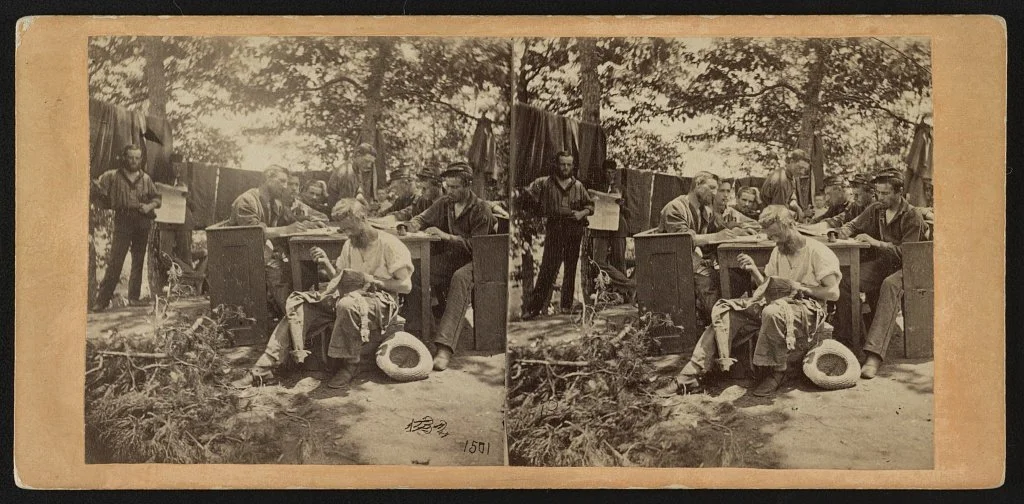
Soldiers of the Boston Light Artillery writing letters at their camp table, June 1861. Stereograph, Library of Congress, Civil War Photograph Collection.
The question of why Confederate soldiers fought has generated its own historiography. The Lost Cause narrative, formalized by Edward Pollard in 1866 and elaborated by the United Daughters of the Confederacy for decades afterward, argued that secession was about states' rights, constitutional principle, and resistance to federal overreach. McPherson's contribution was to take the soldiers' own words seriously without taking them at face value: Confederate soldiers rarely mentioned slavery directly, but the values they articulated, including liberty, property, self-governance, and resistance to coercion, were all structured by slavery's presence in the economy and society they inhabited. The institution did not need to be named because it was the foundation of everything they described wanting to protect.
Both sides believed they were fighting to preserve the heritage of republican liberty; but Davis's last phrase ("all we ask is to be let alone") specified the most immediate, tangible Confederate war aim: defense against invasion. Regarding Union soldiers as vandals bent on plundering the South and liberating the slaves, many southerners literally believed they were fighting to defend home, hearth, wives, and sisters. "Our men must prevail in combat, or lose their property, country, freedom, everything," wrote a southern diarist. "On the other hand, the enemy, in yielding the contest, may retire into their own country, and possess everything they enjoyed before the war began." A young English immigrant to Arkansas enlisted in the army after he was swept off his feet by a recruitment meeting. He later wrote that his southern friends "said they would welcome a bloody grave rather than survive to see the proud foe violating their altars and their hearths." Southern women brought irresistible pressure on men to enlist. "If every man did not hasten to battle, they vowed they would themselves rush out and meet the Yankee vandals. In a land where women are worshipped by the men, such language made them war-mad." A Virginian was avid "to be in the front rank of the first brigade that marches against the invading foe who now pollute the sacred soil of my beloved native state with their unholy tread." A Confederate soldier captured early in the war put it more simply. His tattered homespun uniform and even more homespun speech made it clear that he was not a member of the planter class. His captors asked why he, a nonslaveholder, was fighting to uphold slavery. He replied: "I'm fighting because you're down here."
For this soldier, as for many other southerners, the war was not about slavery. But without slavery there would have been no Black Republicans to threaten the South's way of life, no special southern civilization to defend against Yankee invasion. This paradox plagued southern efforts to define their war aims. In particular, slavery handicapped Confederate foreign policy. The first southern commissioners to Britain reported in May 1861 that "the public mind here is entirely opposed to the Government of the Confederate States of America on the question of slavery. . . . The sincerity and universality of this feeling embarrass the Government in dealing with the question of our recognition." In their explanations of war aims, therefore, Confederates rarely mentioned slavery except obliquely in reference to northern violations of southern rights. Rather, they portrayed the South as fighting for liberty and self-government—blithely unmindful of Samuel Johnson's piquant question about an earlier generation of American rebels: "How is it that we hear the loudest yelps for liberty among the drivers of negroes?"
McPherson, James M. Battle Cry of Freedom: The Civil War Era (Oxford University Press, 1988), pp. 345-346.
James McPherson's Battle Cry of Freedom (1988) won the Pulitzer Prize and became the standard single-volume history of the Civil War era. McPherson is an emeritus professor at Princeton who spent his career on the motivations and experiences of Civil War soldiers; his later work, For Cause and Comrades (1997), analyzed thousands of soldiers' letters and diaries from both sides with quantitative rigor that Battle Cry of Freedom had applied more broadly. Among Confederate soldiers, direct references to slavery as a war aim were rare. The values they articulated instead, including liberty, property rights, self-governance, and resistance to federal overreach, were all structured by slavery's presence in ways the soldiers themselves did not always name. The institution did not need to be named. It was the economic and social foundation of everything they described wanting to protect.
Samuel Johnson's question about the American Revolution, quoted in the passage, applies with even greater force to the Confederacy: "How is it that we hear the loudest yelps for liberty among the drivers of negroes?" The Confederate commissioners sent to Britain discovered this immediately. European audiences could see the contradiction that Confederate soldiers could not, because the Europeans had no investment in the mythology that liberty and slavery could coexist as a coherent political system. The commissioners reported home that the public mind was "entirely opposed" on the slavery question. The Confederacy's foreign policy failed for the same reason its ideology held together domestically: the thing that made the system work at home made it indefensible abroad.