
"Don't let wealth spoil them while they are young." William Langland's post-Black Death advice to parents, from a world where children had become scarce enough to overprotect.
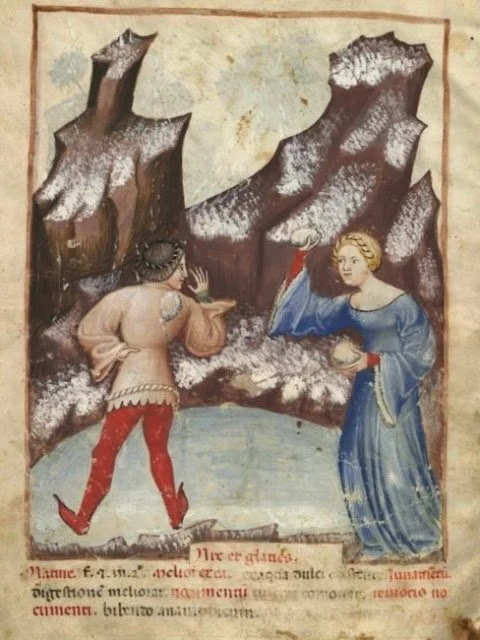
Snowball fight, Tacuinum Sanitatis, folio 96v, c. 1390-1400. Workshop of Giovannino de Grassi. Bibliotheque nationale de France, NAL 1673.
Cecco Angiolieri was a Sienese poet active around 1260 to 1312, remembered for satirical verses of startling venom, including odes wishing death on his father. William Langland, author of Piers Plowman, wrote in the post-plague decades of the late fourteenth century and observed parents spoiling their children out of fear that pestilence would take them. The shift from Cecco's pre-plague world to Langland's post-plague world tracks something most people don’t realize: the modern Western concept of childhood as a distinct, protected phase of life was a historical invention. When plague killed the young disproportionately, children became scarce, and scarce things become valued.
In regard to the post-plague demographic system in which families limited the number of offspring to achieve or maintain greater prosperity, an additional idea is suggested by his argument: with the Black Death and its tragic onslaught, which by many accounts struck down a disproportionate number of the young, a new, more cherishing view of children arose during the late fourteenth and fifteenth centuries. As with many of the plague's reactions, its long- and short-term consequences were often mirror opposites of one another. In the face of the 1348 unprecedented disaster, fathers and mothers may well have abandoned their children, as one contemporary chronicler or story-teller after another reported and repeated. "Oh father, why have you abandoned me? … Mother, where have you gone?" were among the laments recorded by the 1348 chronicler from Piacenza, Gabrielle de' Mussis. Boccaccio ended his lament over relatives abandoning one another by reporting that "what is hardly believable, fathers and mothers [abandoned] their children as though they were not their own, disgusted by seeing or assisting them."
Yet by the time of the later onslaughts of pestilence in the fourteenth and fifteenth centuries, familial sentiments had radically shifted. Here, the complaints of the post-plague William Langland might be compared with those of the pre-plague Sienese poet Cecco Angiolieri. Disinherited from his worldly possessions because of the selfish pietistic zeal of his parents, Cecco penned his famous ode of familial hatred:
If I were death I would go to my father; If I were life I would flee from him; And I would do the same for my mother.
In contrast, a century later, Langland criticized parents of the merchant classes for spoiling their children, and suggested that the plague and rampant mortality may have been the cause of their parental overindulgence:
Don't let wealth spoil them while they are young Nor for fear of the pestilence indulge them beyond reason.
David Herlihy was a medieval demographic historian at Harvard who died in 1991 before completing the book based on his Gauss Lectures. Samuel K. Cohn Jr., his former student, edited and published the lectures as The Black Death and the Transformation of the West in 1997. The book argues that the plague's most significant long-term effects were economic and social rather than medical: labor shortages, wage increases, shifts in inheritance patterns, and a measurable transformation in how European societies valued their youngest members. Samuel K. Cohn's own work, The Black Death Transformed (2002), pushed the demographic argument further, questioning Herlihy's assumption that plague was bubonic and arguing from Italian death records that the disease killed with a selectivity that reshaped household economics across the continent.